Shifting and Articulation on Stringed Instruments

February 12, 2023By SusieUncategorized

Shifting and Articulation on a stringed instrument

(This interview with Susie Mészáros originally appeared in the February 2023 issue of The Strad magazine)

Shifting and articulation are two extremely important elements of making music on a stringed instrument. Pedagogically they are usually treated somewhat separately, but they are connected by their relationship with the human voice. Think of the left hand as the vocal cords, the bow as the breath, and the fingers on the bow as the expressors of articulation – lips, teeth and tongue.

Shifting isn't a necessary evil, it's a wonderful advantage

While beginners are taught to shift between one position and another, and thereby to navigate the fingerboard with confidence, as players become more advanced, shifting should not be seen as merely a technique to build facility. It is complex and when used with imagination has huge expressive power, enabling the violist to engage fully with the music being played.

Listen to any singer and you will understand that the shift is a hugely important part of the beauty of making music. Shifting isn’t a necessary evil; it is a wonderful advantage within the voice of the instrument, just as it is within the character of the singing voice. The role of the bow in the act of shifting is often underestimated. Everything done with the left hand must be supported and reflected with the right. When shifting from a low to high position the student’s bow may hesitate while the shift is in progress, and only once they have arrived will the sound get going again. This will mean that the potential legato line between the two notes is lost.

Articulation gives a phrase meaning

Similarly with articulation, if we are asked to sing a phrase from a piece, we, as speaking creatures, usually refer subliminally to text, so instinctively use some kind of baby-language consonants (such as ‘pa pa pa’) rather than humming, or singing ‘ah ah ah’. The way we use the attack of the bow is directly related to the need to use our lips, teeth and tongue when articulating spoken text. Articulation gives a phrase meaning, so it really matters how notes are lifted, attacked, separated or joined within that phrase. It’s lovely to play lyrically on the string, but listen to the way singers produce their sound. Within their lyricism there are myriad different attacks generated by the text, and small separations caused by the punctuation or the breath, which are expressive in themselves and make the music making human. One change of an initial consonant can make a world of difference to its meaning; the same with articulation in music.

Exercises

Shifting

Exercise 1 is a simple yet effective sliding exercise to expose your shifts and ‘make friends with them’. The bow is used very helpfully to encourage the left hand in its movement. This exercise should be done on all strings, starting on the C string as shown.

Play the following with a down bow as you shift slowly up, and with an up bow as you shift slowly down each time. (Play in the middle third of the bow.) Think of the down bow pulling the shift up, and the up bow pushing it back. This helps establish the relationship between the right hand drawing the left hand with it, and giving a sense of swing. Imagine the slide as the stretching of a piece of elastic. Keep rhythm out of this exercise to give yourself time to think; only shift when you know in your head where you are going, and maintain a neutral and peaceful mindset. Have a think-stop between each down and up bow if this helps.

Articulation

The best place to start is always to sing the phrase you wish to play. Notice which syllables you choose to articulate it, as they are very instinctive. Then think how you might imitate the consonants that you have sung with your bow, imagining that the fingers on the bow are your lips, teeth and tongue. Depending on the gentle or hard attack you have a whole vocabulary under your fingers. Scales are also excellent for practising and exploring articulation.

e1

Studies and repertoire

Here are several examples to help develop the ideas above so that you can find your voice on the viola. The first study shows how you might practise a uniform and consistent articulation for control. The other examples show how those ideas can be incorporated into repertoire.

Example 1 should be practised in the upper half of the bow with an energetic martelé stroke.

Example 2 is a repertoire example that needs powerful, expressive shifting. Pay attention to the tone of the lower note of the shifts for a successful, confident melodic line.

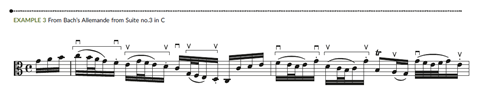
In example 3 (page 91), good articulation is essential. Purists, please look away! I suggest the extra semiquaver (s) be tucked in, rather than using endless up bows, which can give a sense of breathlessness and hyperventilation. Using an energetic stroke in the upper half will give this dance the bite and variety it needs.

ex12

ex3

In your practice

  • Vary the amount you practise if you are pushed for time, but keep to this scheme and do it daily:
  • Warm up with structured and limited exercises such as left-hand finger patterns in one position. Aim for rhythmic playing, evenness of sound and bow speed (I recommend the Schradieck exercises).
  • Do exercise 1 to warm up the arm both mentally and physically. Remember to shift only when you know where you are going, both pitch-wise and with your arm. Actively imagine the physical feeling of the destination position. You may like to model the arm movement before playing too.
  • Move into scale practice (choose one three-octave scale a day)
  • Do some studies (don’t forget to include double-stops)
  • When practising repertoire, actively think about singing, firstly out loud, then in your head as you play

Tips for teachers

  • The voice, which is constricted by the confines of the breath, is a critical example on which to draw
  • Always explain why you are teaching a particular skill
  • Students have a library of memory built up from having been everywhere on the fingerboard at one point or another, and on every finger. When shifting, encourage students to tap into this library, sensing the new position before shifting to be confident in the movement; students need to gain trust in their knowledge of the instrument to let things happen.
  • Start students with small shifts of a tone or a semitone as these aren’t seen as scary, and as they gain confidence allow them to progress to larger intervals incrementally, as shown in exercise 1
  • If students are finding it difficult to shift, ask them to stay
  • in the low ‘springboard’ note, aim their ears to the pitch of the higher note, imagine the feeling in the left arm at the destination note, then let the arm take them there as a neutral result of the planning. Just as we have ‘mirror, signal, manoeuvre’ in driving, we have to think before we shift.
  • The bow is a very important part of any shift. If the first note is played with a good tone, it shows that the student has the patience to stay in the moment both physically and tonally before setting off on the shift.
  • The arc of the bowing arm as it moves along the string propels itself rather like the swinging of a pendulum and makes its way effortlessly. This arc-like movement should link to the arc of the left hand when it shifts.
  • Don’t forget to demonstrate and use analogies that are relatable for your students.

INTERVIEW BY NAOMI YANDELL

Further materials
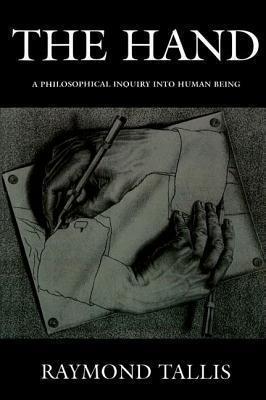
 

Extra materials The Hand

The Hand: A Philosophical Inquiry into Human Being by Raymond Tallis is a fascinating and fun read about human agency and how our hands and our human selfhood evolved side by side.

Piano Trio Postgrad Coaching Royal College of Music, London

November 15, 2021By Susie Meszarospiano trio coaching

Coaching a New Piano Trio

a post grad piano trio with Susie Meszaros

I’m here with 3 Royal College of Music postgrads; Daniel (piano), Lotte (cello) and Sangbin (violin), who I’ve not actually worked with before. We were in the East Parry room, a performance space right at the top of the Royal College. Looking out of the window on one side you see the Royal Albert Hall.

This first time, we had just an hour.  They’re a very promising group, all of them approaching really intelligently, with great dedication. All players are very advanced instrumentalists. You can really help them get very deep into the music, because they have no technical challenges. It’s working with a marvellous material already. I can really push forward and challenge them in a musical sense. We did some really good work in a very short space of time.

It’s lovely when you get to the heart of good heart ideas in a very short space of time.

Schubert E Flat Piano Trio

They played the slow movement of the E flat piano trio by Schubert – which needs a lot of sustaining. It doesn’t play itself. It’s quite protracted music and so you have to sustain it with really intelligent ideas about phrasing, about how you produce your sound, how the piano and strings can play together, because of course, they’re such different instruments to each other, but they must blend together. 

Comparing string quartet with piano trio

It’s easier in a string quartet because you have four instruments in the same family. In a piano trio, you have two stringed instruments. The action of the piano and the way it produces everything is completely different. Piano has to learn from strings and vice versa. They need imitate each other when necessary and be very different at other points in the music. It takes a lot of thought, observation and listening.

I teach at Royal of Music, London and Royal Northern College of Music, Manchester. Find out more about my private teaching for amateurs, professionals and in person and online via Zoom.

Royal College Music Professor Talks Beethoven String Quartet

July 24, 2020By Susie MeszarosTalking Beethoven Op. 18 No. 3


Susie on Beethoven's String Quartet Op 18 No. 3

Extract: In this short video talk, Royal College of Music, Royal Northern College Music Professor, Susie Mészáros, contextualises Beethoven's longing, searching for a more transcendent spirituality, reflected in his music, within the context of the Enlightenment. Beethoven was in his late twenties. It was only at this stage in his career after writing trios, violin and cello sonatas, septets, that he felt ready to take on the medium of the string quartet. There is nothing ostentatious about this string quartet. Beethoven could almost pick up a tune from the street and craft it into something extremely sophisticated and beautiful. This quartet still has all the hallmarks of classical writing and structure, except his journeys into keys, into texture and kind material he uses, which is perhaps more fragmentary and elusive than his predecessors, Haydn and Mozart.

The Budapest String Quartet performance 1951

(Listen to the Budapest String Quartet play Op 18 No. 3 below)

The Budapest String Quartet (Joseph Roisman - Jac Gorodetzky - Boris Kroyt - Mischa Schneider)
Studio recording, 29.XI.1951

tonal purple illustration of Beethoven

Personal Memory of Mischa Schneider

A curious personal recollection of my own. In 1983 I was in the Marlboro Summer School in Vermont, which had been started by Rudolph Serkin and Adolf Busch.  I worked closely with Mischa Schneider who at that time was too old to play, but sat in on all rehearsals and coached us every day. One really felt the depth of understanding for the music and quartet playing.  His help was musical, intellectual, practical. He was a very personable man.

It felt like holding the hand of history. I remember feeling that he continued to discover the music himself. It felt like he was playing in the quartet.


RNCM Masterclass 3 videos: Walton Viola Concerto

April 18, 2020By SusieViola masterclass RNCM, Chamber music coaching, Music Appreciation, viola

3 short films RNCM Viola Masterclass

In these three short films, RNCM viola and violin professor, Susie Mészáros covers Walton's Viola concerto, performed by student 'Susie' Xin He at Royal Northern College of Music, Manchester.  The performance is approx. 8 minutes long, and is a public RNCM viola masterclass. Parts 2 & 3 explore performance, ideas and dynamics. The videos show ways that string playing can be improved in subtle but decisive ways.

For further insight into Susie's chamber music coaching ideas, see:

Short film: Coaching Royal College of Music string quartet players

Royal Northern College of Music Masterclass given by Susie Mészáros January 2020 featuring Xin He Part 1 of 3

Royal Northern College of Music Masterclass given by Susie Mészáros January 2020 Part 2 of 3

Royal Northern College of Music Masterclass given by Susie Mészáros January 2020 Part 3 of 3

Schumann Sonata Violin & Piano Op. 105 performance video

April 16, 2020By SusieSchumann sonata performance

On Playing violin and pianist, Stephen Coombs

Susie and Stephen Coombs perform Schumann Sonata for Violin and Piano Op. 105 at Balliol College, Oxford to celebrate the 85th birthday of Alan Montefiore, 2011. 

Here I’m playing the violin. If there’s one great advantage to the violin,  it’s the incredible breadth of wonderful repertoire. Much though I love playing the viola within my quartet, I’ve also hugely enjoyed my role as first violinist in the Fitzwilliam Quartet and leading the Kent Opera orchestra under the baton of Ivan Fischer

Apart from being a wonderful pianist, Stephen is a Russian orthodox priest. He is a solo artist for Hyperion and is a gold medallist at the first Liszt competition in Hungary. You can see an interview with Stephen and flautist, Ileana Ruhemann with Dr Timothy Ewers

Komitas Songs | Armenian Genocide

April 10, 2020By Susieviola, Armenian genocide commemoration

Susie Mészáros reflects on the 10 songs by Komitas performed by the Chilingirian Quartet to commemorate the centenary of the Armenian Genocide in 2015


(see the Armenian Genocide multimedia project with the songs performed and comments by Levon Chilingirian here) 

This year marks the centenary of the Armenian genocide, which saw the systematic extermination and displacement of a million and a half Armenians by the Turkish state in it’s attempt to rid the Ottoman Empire of an entire Christian people. Such was the scale and cruelty of this genocide that Adolf Hitler himself referred to it when he was preparing to invade Poland, exhorting his generals to be merciless and brutal: “Send to death mercilessly and without compassion men, women and children…Only thus shall we gain the living space we need. Who, after all, speaks today of the annihilation of the Armenians?”

During the early years of the 20th century and leading up to 1915 an Armenian priest named Komitas was collecting folk songs in much the same way as Bartok and Kodaly did in Hungary – recording and transcribing for posterity the music of the Armenian people. Komitas survived the purge physically, but was mentally destroyed by the experience and spent the rest of his life in anguish, eventually dying in a Paris asylum. Among the Armenian diaspora were many musicians such as the family of Levon Chilingirian, the leader of my quartet, who fled to Cyprus. Also among these was Sergei Azlamazyan, an Armenian cellist and composer and co-founder of the Komitas Quartet who eventually settled in the Soviet Union. Azlamazyan wanted to be able to perform music from his homeland and so arranged for string quartet a number of songs from those collected by Komitas.

My quartet decided it would be a fitting tribute for this important anniversary to film performances of ten of these songs and release one song every three days leading up to the official commemoration day of 24th April. Along with the films there is a wonderful archive of photographs from the family album of Levon Chilingirian and his wife, also Armenian. Levon was the nephew of the great violinist Manoug Parikian, who appears in some of these rare and precious photos. The performances of the songs are interspersed with archive pictures, and the two together make a most poignant and touching record. The songs were filmed in the Armenian church of St Sarkis in London, and the project was devised and produced by filmmaker Kevin Laitak.

There is nothing quite like music to evoke the spirit of a people, the intangibility of which tells certain things more eloquently than words. In music we hear suggested the pattern of language through rhythm, inflection and articulation; the essence of a people’s relationship with dance and movement born from physical activity and labour (think of all the spinning, threshing, ploughing songs…); the overarching mood and disposition of a nation’s psyche. It is a call to the senses in a very direct way, bypassing the cerebral and overtly conscious. Folk songs are passed down through generations as an aural tradition much as the art of playing an instrument is passed down from master to student, by example. So classical musicians revisiting folk song are reminded of the building blocks of their own musical tradition which over time naturally evolves into something more sophisticated, abstract and self-conscious through its refinement. It’s good to make that journey back to one’s cultural fatherland once in a while.

These particular songs are a joy to play. As violist in a quartet my role in repertoire like this would for the most part be fairly fixed and determined. I would mainly be accompanying in the traditional way, providing harmony, texture and rhythm. But happily the viola part has been quite generously provided with solos in these songs, used as it were as an alternative vocal line – the contralto perhaps. The joyful Vahan-Bedelian (1) “hoy Nazan Im” is a boisterous greeting song where the viola stabs through with syncopation and bubbling, rippling lines.

'Shoushigi', dedicated to a little girl, features a most warm and loving melody which is taken over by the viola for a whole verse. I adore playing this one, with its lilting dotted rhythms and sweet line. In some songs, such as 'Al Alayloughs', the viola has the last word, reminiscing the melody in a more wistful way to round off the song. Quite often the viola makes melodic interjections and commentary, such as in the lugubrious middle section of 'Shogher Djan', dragging the other instruments as if by gravity into the deep viola voice. At other times it provides waves of the most rich and searing harmonies – delicious and seductive
.

'Kelly Kelle' is a conversational song about a woman’s admiration of a man’s walking gait! The viola strides along with the main melody, radiating vibrant warmth from the lower strings. Just because the register of the viola is lower than the violin’s doesn’t mean it necessarily depicts the male character – to me it is a deep and mature woman’s voice.

'Karoun A' – the sad Spring song which speaks of a young lady who loses her love. The viola seems to be mourning, weeping long sorrowful notes over and over. 'Echmiadzni Bar' is a wild dance, very eastern in character, throughout which the viola plays the same tune as the violin but an octave lower. It is tough and gutsy, later becoming dreamy and filigree, then bursting back to its former punchiness.

'Haprpan' – a boy/girl song, full of conversation and fun, loving and longing. The viola is very busy with rhythms both bowed and plucked as well as the occasional cheeky interjection. The remarkable thing about these songs is the absence of awkwardness in marrying one form – folk song – with the medium of classical instruments. There seems to be no fault-line between the two elements, the best of each shining with ease and without compromise. There is richness, there is simplicity. Azlamazyan uses the instruments in a quite classical way without ever resorting to over-folkiness, yet we are without a doubt hearing folk music.

This has been a most powerful and fulfilling project. These songs are important because they are a magic thread that links us to a society that was all but obliterated. It’s astonishing how the songs together with the images connect us in a very human way with a terrible history that is not widely known in the West. We’ve had incredible feedback on the films, so the last word is from Arderne, one of the many people who wrote to us: “The music is so vibrant and sparkling, which is the more poignant when you consider the horrors which were to overtake these people. It has been a revelation and a joy.”


(Article first published in the British Viola Society newsletter, May 2015 to commemorate Armenian Genocide centenary 24th April 2015)

Sandor Vegh – His Musical Ideas

April 9, 2020By SusieSándor Végh, Chamber music coaching 1 Comment
Sandor Végh walking with his grandson

Sándor Végh – My Teacher at Camerata Salzburg

In this short video, Susie Mészáros, professor of music at RCM, RNCM and viola player with the Chilingirian Quartet talks about music, ‘Hollywood vibrato’ and her teacher, Sándor Végh’s influence.

Susie first met Sándor Végh at Prussia Cove, aged sixteen, going to study with him in Salzburg for two years, playing as principal violist in the Camerata Academica Salzburg, which he conducted, and studying with this fascinating and demanding teacher.  Featured is an interview with Susie in June 2021, where she talks about the transformative influence Végh brought to her understanding of music, musical voice and a very grounded philosophy of playing, which gave her absolute confidence in her musical ideas. The video features footage of Royal College of Music student quartets, which illustrates some of the ideas she learnt from Sándor Végh. She debunks the cliché of the furrowed brow string player, all intensity and emotion. As her decisive musical influential teacher would say sometimes, “it’s too beautiful to be true!”   Life is richer, subtler, has fragility.

Interview transcript: My Studies with Sándor Végh 

[June 2021] first met Sándor Végh when I was 16 years old, at the International Musicians Seminar at Prussia Cove in Cornwall. I went there to take part in master classes and continued to playing chamber music with Végh himself. He was teaching and playing and I found him absolutely fantastic. A revelation of ideas for me, and a huge personality. His playing and teaching were so rich and just so direct. He spoke in terms that really resonated with me. He talked about the physics of music and the imagery he used was very natural and comprehensible. He explained about things like tension, relaxation and breathing in a really clear way.  He seemed to like my playing very much, took a great interest, and I would play alongside him frequently too. But at that stage I didn’t consider going to a violinist for my college studies.

Telegram from Végh – ‘Come Now!’

Later, when I needed to look for a teacher seriously, I wrote to him asking for advice. He immediately said, ‘Come now!’ He actually wrote that in a telegram! I had been unhappy where I was so when I received that telegram I just packed my bags and went to Salzburg! I was lucky enough to be appointed principal Viola of the Camerata Academica straight away, performing and touring a lot. That was my first professional job, aged 19.  So I immediately was working all the time with him, as a chamber musician, as an orchestral principal with him as conductor. And, of course, as the only violist in his wonderful violin class.

The Teacher’s Gift to Students – Independence!

I stayed with him in Salzburg for about two years. But those two years were packed. I felt that he gave me the tools to completely understand what I needed in my own playing and how to keep developing. A great teacher gives the gift of independence to a student, in the sense of opening their eyes and ears and mind to the tools to be able to tackle everything in their own playing themselves. I found I was beginning to lose any doubts about my musical and instrumental ideas. I realised I could very quickly tackle technical problems that for a long time I’d gotten away with; you know, bad habits or failings in certain technical areas. And suddenly, I felt that I was given a clear insight into the philosophy and practical approach of what a technique is; that it’s not just certain exercises, or this or that book of studies, or repetitive things, but actually understanding the why, rather than just the what. Question: So Sándor kind of really transformed your idea of music? What were the limitations of the kind of the teaching you were getting previously?  Well, I felt that because I’m quite a natural player, and I’d had a very good training in an intensely musical context in a specialist music school. I had taken many things for granted. I started playing when I was eight, which actually isn’t all that early, but at age 10 I went to the Menuhin School and absorbed a lot from a great range of musicians. It was a really rounded education. It taught me to be very disciplined. But I think that the one thing I didn’t have, as a musician and as an instrumentalist, was a backbone to my playing, of really understanding what was going on.

‘To Give only what you feel is there. And not to lash on emotion. To pump emotion into playing is almost fraudulent. Sándor Végh, he was my teacher.  Végh used to emphasis not to be afraid to do less. Life is also fragile, vulnerable, not always beautiful.  Végh was scathing about lashing on the emotion. He called it, “Hollywood Vibrato”

I knew what I should do to practice, but I didn’t quite understand the central column of what makes one listen and join one thing to another. I think it was Végh’s idea of uniting the technical, the musical, the intellectual and the human. So all of a sudden I felt that I was able to connect those many dimensions that had up til then been rather separate elements.

Practice, left & right hands, finger flexibility, dexterity

For example, practising the left and the right hands – yes they are very different, they have very different roles of course, and they must be independently exercised, you know, and the elements must be really broken down very clearly. Like finger flexibility and dexterity, shifting, bow control in a horizontal sense, bow pressure.. things like that. But then bringing the two hands together so that what one hand does, the other is reflecting because, really, you may have two hands, you may have a bow and a violin, but you have one sound. We are best when we play a violin or a viola as one voice. Just as a singer has vocal chords, they have lungs to propel the air, they have lips, teeth and tongue etc.. so you should also think about these elements within the bow. Enunciating text, for example, is pretty much the same as right hand articulation. Within the human voice these are innate. We walk around with all of those things in the one body all the time, whereas we have to manufacture stringed instruments – they’re machines, tools, and we have to then bring all those mechanisms back together for the creating of that one voice.

Like being out of focus -Suddenly two blurred images come together

The violin and viola are our lyrical instruments. That’s what I felt had suddenly became so coherent with Sándor. What I was doing in the left hand was perfectly reflecting what was in the right and vice versa. It’s like having been seeing out of focus and suddenly the two blurred images come together in one. And that’s the central point of my own teaching; it is always to see, to show, how especially the right hand can really influence the left in terms of tonal variety and things like vibrato, intensity, shifting..all of these things.

The Voice – What I learnt as leader of Kent Opera Orchestra

In 1984 I became Leader, concert master, of the Kent Opera orchestra. Suddenly I was exposed to opera in all its glorious forms. The colour, the costumes, the direction, the theatre, the music, the voices, the personalities, the wonderful chaos. It was just a fantastic immersion. I fell in love with singing and decided that I wanted to learn singing myself. I had a nice enough voice, it wasn’t a great voice but what I enjoyed was just to understand it for myself, how to use it properly, all the many elements. And that also fed into a unique

Swallow your violin or viola – Singing with your instrument

experiencing of the most intimate relationship with sound – you have your instrument inside you as a singer and when you start understanding that, in a way I found I was able to ‘swallow’ my violin in the same way as I contained my voice inside my lungs, my throat, my mouth – you start doing that with your instrument too when you have a sense of singing.  Because it is exactly those things. Who doesn’t want to sing on their instrument? Who doesn’t aim, if they’ve played a string instrument, not to sing? But to speak as well – of course. Végh was always taking about ‘speaking’ on the instrument, it was not enough just to sing. He always went on about that. Because why on earth would we have sophisticated bow articulations if it wasn’t to reflect in some way spoken text? Consonant, vowel, articulation.. So I was Leader of Kent Opera orchestra with another very inspiring Hungarian, the conductor, Iván Fischer. So exciting and excitable..an innovative conductor. He’s a world class musician and I very much loved working alongside him. From an interview with Susie Mészaros 4 June 2021

Ask about Zoom Lessons with Susie

Lockdown restrictions have popularised Zoom lessons. In the past year, I have been teaching many student and amateur players over Zoom. It’s enabled me to teach people remotely. It’s shown that geography can be overcome for constructive violin and viola coaching. I’ve been teaching Chinese students based in China and amateurs based across the UK during 2020-21. 

Are you interested in a consultation?

Have you played in the past and would love to return to playing as an amateur or work on aspects of your playing? There’s no ‘one size fits all’ solution. Every amateur player has their particular strengths and weaknesses. Read more on my amateur violin or viola teaching Contact me using this link

Bartók’s 2nd Quartet – Levon Chilingirian

April 9, 2020By SusieChilingirian: Bartók's 2nd Quartet

Bartók's 2nd Quartet -Podcast with Levon Chilingirian

In 2016 the Chilingirian Quartet performed all of Bartók's quartets at Kings Place, London.
This is a short podcast from that time.

As part of a continuing series of podcasts by the Chilingirian Quartet, Levon talks on Bartók's 2nd Quartet ahead of their Kings Place, London concert, February 7th 2016. This historic series of six concerts to be given by the Chilingirian Quartet, commemorates the 70th anniversary of Bartók's death by reconstructing the first complete cycle of Bartók quartets in the UK – given in the 1949/50 season by the London Chamber Music Society's precursor organisation, the South Place Sunday Concerts.

Bartók's 2nd Quartet -Podcast with Levon Chilingirian OBE

Levon Chilingirian OBE on Bartók's 2nd Quartet 

Talk transcript

"I think that's when people see the name Bartók in programs, even now feel they like running away sometimes.

I think it's something that's still, even now, unjustified. It's something that we're trying to put right with a series that, you know, we're giving over the next two years at Kings Place. We're repeating the exactly the same programs that were given in 1949/50 at the Conway Hall -the first time that all the Bartok quartets were played in London.

This is the second concert. And so we've done already number one, Bartok number One. The second one we play number two, which really is the most approachable of the quartets. And actually I say to student groups, and to amateur groups, that it's the most playable. They can play this. Maybe for the amateurs that they might play, not as fast as Bartok marks sometimes, but it's eminently playable. It's a real String Quartet with amazing new things in it. This is a, I think, the best introduction to Bartok's music, and particularly to string quartets.

Arabic themes

He incorporates some Arabic themes. I don't think people are aware of so much that Bartok who was trolling around East of Europe. Of course, collecting Hungarian music, Hungarian melodies and because the neighbouring countries are Romania and Ruthenia and Moldova, you know, all those - The style of music, and the ethnic music he was familiar with. But before writing his second quartet he made a trip to North Africa, and he picked up one or two things from there in the middle movement because this is in three movements. In the middle, boom! And there's some real good Arabic music, and of course it's incorporated with Hungarian rhythms, but the actual melodies are wonderfully different.

So, you have a very unusual piece of music that the middle movement is the fast, lively, fun, sinister, dry humoured, but basically fast movement. You have the first movement which is very lyrical and very gentle wistful. He wrote this, don't forget, between 1915 and 1917, so it falls into that very sad period when the Europe was at war. So he, it's very wistful, and very sweet and very expressive, and then having played this crazy Hungarian Arabic second movement which sort of goes mad sometimes, he follows it with the, with a third or last moment which is bleak. Absolutely, dark, dark clouds, hopeless. Everything that you, you might want to describe you know, the hopelessness of the situation in Europe in at that point, the First World War. It's very static. It's very expressive. And then it's very non expressive, very black. And yet, everything in this work is, I think, totally understandable.

It's not overly dissonant, it's not overly brutal, that comes a little later, with particularly three, four, five. It was written for the Hungarian quartet. This is the original one, and they premiered it before the First World War was over in Budapest, so that must have been an interesting first premiere.

It is compact, relatively speaking, and it's in a sandwich in this concert, where we've retained the original programs from 1949/50, the sandwich consists of a Mozart quartet, some might say, his very greatest quartet, a very unsung great quartet, his quartet in A major and I would only say one small thing about it. This is the piece that Beethoven, loved. He went as far as to copy the last movement of this Mozart quartet in his sketchbook. And when somebody said to him, "what is this?" He said, "now, there is a piece!"

For Beethoven to compliment, Mozart, which of course he acknowledged him as a great composer, but to actually pick up this particular piece as the one that he thought was Mozart's most interesting is, I think, is enough for me to place it right at the very very top.

It's interesting his longest quartet. Oh, it's a wonderful start if you like with this great Beethoven, like Mozart quartet, and then in the second half to end, we play the like champagne quartet of Beethoven his G major quartet. Unbelievable fun and games, three out of the four movements, and then a beautiful, serene miracle slow movement, but with a surprise in the middle, where, he writes some incredibly fast music. So this is a very joyful piece. And there you have a fantastically contrasting program, this central work, which I suppose was the focus of the very first cycle in London, and of course it's the focus of our present cycle.

The technical challenges

Technically, his music is challenging away from it.
Now having lived with this music for 40 years now, it feels simply like a wonderful string quartet, like a Haydn quartet. And the technical challenges have to be met by each individual member of the quartet, whichever quartet it is, ours, another group, and yet, as with other music, You have to bring out the phrasing, and moods, the articulation.

So, if a group plays Bartok in a, either in a panic-stricken way, because they can't play it individually or in a, what I would call a sort of, contemporary frame of mind, rather than putting it as a son of list, something that is fundamentally based on music that they, the listener, will know and understand the love. And Bartok Of course it is own character his dry, strong shy character, and uncompromising technical compositional style within all of that, there is real music.

So, what I would challenge, is whether enough performances of Bartók, particularly these earlier pieces, number One, Number Two, which have enough musicality and lyricism, and the technical problems, should not surface for the listener.

Bring out the Music, technical problems shouldn't surface

So the players have to be good enough just to bring up the music. I think it's very simple, like that.
So it sits in particularly this program, I think it's very interesting it sits so comfortably for me within these great two pieces by Mozart and Beethoven,. You would, I hope, recognize it as a, as just another quartet written by another great quartet composer. We'd have a lot of fun. We are having a lot of fun rehearsing right now. Interestingly enough, you know, two of us, Ronnie and I, have played this many, many, many, many, many, times. And in this case, it's new for Susie and Steve, they are so familiar with the style of Bartók, and we've done many Bartok quartets before, so it's also the exciting.

I think around to explore this wonderful piece with with two of us having done it a lot and two of us doing it for the first time. I think that element of it, is making it to like a fresh interpretation, working out how to go around the corners.

If I had to tell the difference between Bartok and Mozart or Bartók and Beethoven, it's the change of speed, what we call tempo, it's these changes which are much much more frequent most speeding up most learning more different tempos; just much more if you like romantic, like some of your play Chopin you know, pull it about.
Well, there's that very strong element in Bartok and in the slow movements he's always subtly changing the tempo, officially changing it. Mozart and Beethoven might have signaled to us in a slightly different feeling. Without marking it, we as the interpreters have to know that, but Bartok clearly marks slower faster, much faster 10 times faster 10 times slower. So, I guess for the performance and for the listeners., that is a challenge. But again, I think it's up to the performers to for to do it, not to make it sound like a mathematical problem or equation. Again,  sometimes people think that you need to be mathematical to play Bartok. I think, Of course you need to be able to count. But I think you need good rhythm. I go back to one of the most brilliant mathematicians in history, Albert Einstein, by what we know about stories about him, because he played the violin. It seems that he had shockingly bad rhythm.

So, good rhythm is not the same as being good at mathematics, some of the best mathematicians, are the most rigidly unmusical players. They might play all the notes and they might think they're doing it brilliantly but they have no feel for rhythm. And so, in Bartók, you have to play very complex stuff, but with basically good rhythm. And that comes with birth, from birth. ha!

And so you know Bartok was basing his music on living alongside and amongst great folk Fiddler's and singers who would never went to music school or anything like that, they just were natural musicians.

If you would like to come to the concert at Kings place. I would strongly recommend to come to the pre concert talk just to, you know, hear about it and maybe get familiar with it, and then come with absolute open ears and almost like, just listen, you know there'll be a piece at the beginning and there'll be a second piece and it just happens, and the second one is the Bartok II. You don't need any special preparation. I think it's so beautiful and so clear if we do it. Well, then you have no problems as an audience, and this could be the your entry point into what he does later.

And we'll be doing the third quarter of course in March, wonderful piece much shorter. So again, very easy to handle more wild more sort of real wild stuff in that, but I think again, very straightforward, when it comes to it. And then next year four, five and six so I think number two is, is the big one for just understanding, getting into the style.


String Quartet Coaching – by Susie Mészáros

April 8, 2020By SusieChamber music coaching

Chamber music Coaching for Students, Professionals & Amateurs

I'm Susie Mészáros, chamber music professor at the Royal College of Music and the Royal Northern College of Music and violist with the Chilingirian Quartet.

I'm based in Manchester where I teach string quartets and give chamber music coaching at the RNCM. I work with young players, teach private students and amateurs. I offer Zoom online teaching.

String Quartet Coaching in time of Covid

We've all become familiar with Zoom teaching over the past year. Zoom has opened up teaching students and amateurs from across the country. I have students in China, Turkey and across the north West of England. If you're curious about how this works, contact me here for more details.

Describing My Teaching Approach

My website features many videos, interviews with students, masterclasses which can give you some idea of how I teach. I'll be adding new resources frequently. You can see 3 short masterclass videos on Walton's Viola Concerto at Royal Northern College of Music with, 'Susie Xin, in January 2020.  Or find out about my decisive musical influence and teacher, Sándor Végh.

I’m looking forward to exploring aspects of string quartet performance and teaching, aimed at young professionals, amateurs. I will be looking at issues in performance, areas that feature with conservatoire students, essentially getting to grips with aspects that challenge players.

Hopefully it should be interesting, illuminating and of value to student quartets and amateur players.

As part of this, I'll be featuring short videos, interviews and podcasts with myself, young players and professional colleagues. The best learning and insights come from dialogue. I look forward to hearing from you!

Best wishes at this time of Coronavirus

Susie Mészáros

Philip de Groote The Chilingirian Quartet

March 29, 2018By SusiePhilip de Groote

Philip de Groote (1949-2018)