

Shifting and Articulation on a stringed instrument
(This interview with Susie Mészáros originally appeared in the February 2023 issue of The Strad magazine)
Shifting and articulation are two extremely important elements of making music on a stringed instrument. Pedagogically they are usually treated somewhat separately, but they are connected by their relationship with the human voice. Think of the left hand as the vocal cords, the bow as the breath, and the fingers on the bow as the expressors of articulation – lips, teeth and tongue.
Shifting isn't a necessary evil, it's a wonderful advantage
While beginners are taught to shift between one position and another, and thereby to navigate the fingerboard with confidence, as players become more advanced, shifting should not be seen as merely a technique to build facility. It is complex and when used with imagination has huge expressive power, enabling the violist to engage fully with the music being played.
Listen to any singer and you will understand that the shift is a hugely important part of the beauty of making music. Shifting isn’t a necessary evil; it is a wonderful advantage within the voice of the instrument, just as it is within the character of the singing voice. The role of the bow in the act of shifting is often underestimated. Everything done with the left hand must be supported and reflected with the right. When shifting from a low to high position the student’s bow may hesitate while the shift is in progress, and only once they have arrived will the sound get going again. This will mean that the potential legato line between the two notes is lost.
Articulation gives a phrase meaning
Similarly with articulation, if we are asked to sing a phrase from a piece, we, as speaking creatures, usually refer subliminally to text, so instinctively use some kind of baby-language consonants (such as ‘pa pa pa’) rather than humming, or singing ‘ah ah ah’. The way we use the attack of the bow is directly related to the need to use our lips, teeth and tongue when articulating spoken text. Articulation gives a phrase meaning, so it really matters how notes are lifted, attacked, separated or joined within that phrase. It’s lovely to play lyrically on the string, but listen to the way singers produce their sound. Within their lyricism there are myriad different attacks generated by the text, and small separations caused by the punctuation or the breath, which are expressive in themselves and make the music making human. One change of an initial consonant can make a world of difference to its meaning; the same with articulation in music.
Exercises
Shifting
Exercise 1 is a simple yet effective sliding exercise to expose your shifts and ‘make friends with them’. The bow is used very helpfully to encourage the left hand in its movement. This exercise should be done on all strings, starting on the C string as shown.
Play the following with a down bow as you shift slowly up, and with an up bow as you shift slowly down each time. (Play in the middle third of the bow.) Think of the down bow pulling the shift up, and the up bow pushing it back. This helps establish the relationship between the right hand drawing the left hand with it, and giving a sense of swing. Imagine the slide as the stretching of a piece of elastic. Keep rhythm out of this exercise to give yourself time to think; only shift when you know in your head where you are going, and maintain a neutral and peaceful mindset. Have a think-stop between each down and up bow if this helps.
Articulation
The best place to start is always to sing the phrase you wish to play. Notice which syllables you choose to articulate it, as they are very instinctive. Then think how you might imitate the consonants that you have sung with your bow, imagining that the fingers on the bow are your lips, teeth and tongue. Depending on the gentle or hard attack you have a whole vocabulary under your fingers. Scales are also excellent for practising and exploring articulation.

Studies and repertoire
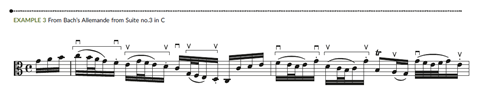
Here are several examples to help develop the ideas above so that you can find your voice on the viola. The first study shows how you might practise a uniform and consistent articulation for control. The other examples show how those ideas can be incorporated into repertoire.
Example 1 should be practised in the upper half of the bow with an energetic martelé stroke.
Example 2 is a repertoire example that needs powerful, expressive shifting. Pay attention to the tone of the lower note of the shifts for a successful, confident melodic line.
In example 3 (page 91), good articulation is essential. Purists, please look away! I suggest the extra semiquaver (s) be tucked in, rather than using endless up bows, which can give a sense of breathlessness and hyperventilation. Using an energetic stroke in the upper half will give this dance the bite and variety it needs.

In your practice
- Vary the amount you practise if you are pushed for time, but keep to this scheme and do it daily:
- Warm up with structured and limited exercises such as left-hand finger patterns in one position. Aim for rhythmic playing, evenness of sound and bow speed (I recommend the Schradieck exercises).
- Do exercise 1 to warm up the arm both mentally and physically. Remember to shift only when you know where you are going, both pitch-wise and with your arm. Actively imagine the physical feeling of the destination position. You may like to model the arm movement before playing too.
- Move into scale practice (choose one three-octave scale a day)
- Do some studies (don’t forget to include double-stops)
- When practising repertoire, actively think about singing, firstly out loud, then in your head as you play
Tips for teachers
- The voice, which is constricted by the confines of the breath, is a critical example on which to draw
- Always explain why you are teaching a particular skill
- Students have a library of memory built up from having been everywhere on the fingerboard at one point or another, and on every finger. When shifting, encourage students to tap into this library, sensing the new position before shifting to be confident in the movement; students need to gain trust in their knowledge of the instrument to let things happen.
- Start students with small shifts of a tone or a semitone as these aren’t seen as scary, and as they gain confidence allow them to progress to larger intervals incrementally, as shown in exercise 1
- If students are finding it difficult to shift, ask them to stay
- in the low ‘springboard’ note, aim their ears to the pitch of the higher note, imagine the feeling in the left arm at the destination note, then let the arm take them there as a neutral result of the planning. Just as we have ‘mirror, signal, manoeuvre’ in driving, we have to think before we shift.
- The bow is a very important part of any shift. If the first note is played with a good tone, it shows that the student has the patience to stay in the moment both physically and tonally before setting off on the shift.
- The arc of the bowing arm as it moves along the string propels itself rather like the swinging of a pendulum and makes its way effortlessly. This arc-like movement should link to the arc of the left hand when it shifts.
- Don’t forget to demonstrate and use analogies that are relatable for your students.
INTERVIEW BY NAOMI YANDELL
Further materials

The Hand: A Philosophical Inquiry into Human Being by Raymond Tallis is a fascinating and fun read about human agency and how our hands and our human selfhood evolved side by side.