Contents
- 1. 'Inspiring' viola teacher at RNCM & Royal College of Music - Susie Mészáros
'Inspiring' viola teacher at RNCM & Royal College of Music - Susie Mészáros
Young musicians studying at music conservatoires bring their particular challenges. It is the journey of making the transition between your imagination and the physicality of playing. You are developing your own unique voice, to use your instruments in your hands to directly express what is intangible. This is the bridge that all mature musicians must cross.
Your teacher has to have a good understanding of your strengths and weaknesses. And they also need to understand what you, the student, are looking for.
'Susie regularly references what her teachers told her. There’s one thing in particular. I was learning the Walton Viola concerto. We were going through the fingerings. She was like, 'Yeah, these are Yehudi Menuhin's fingerings’. It’s very inspiring in a way, because while I’m not Susie, I’m coming along that same family tree of musicians'
How do you find the right violin, viola teacher?
Personality plays a large part of the part in it.
My students value my teaching because I bring a big element of fun and playfulness to what they're doing.
I don't make a very austere difference between student and teacher. Because we're finding a way forward together, rather than having readymade things imposed from outside.
The starting point for my teaching is that it is bespoke. It's not just imparting what I know from my own experience but what I discover from the student who stands before me, what are the imbalances in your particular playing. All students have strengths and weaknesses and there is really a huge range. You can't ever actually just say that somebody is not a good player or a good player. There really are lots of variations and subtleties in it.
Viola graduates video interviews - What it's like studying with Susie Mészáros
Theo and Wanshu talk about their experience being taught by Susie over 4 years at Royal Northern College of Music, Manchester
Finding the thing that is strong in your playing gives you a wonderful confidence. That's a sound basis to then pin everything on to that strength. That is why I like to look at what people have got already.
I studied at the Yehudi Menuhin School. Sándor Végh was the decisive influence on my ideas of music with whom I studied in Salzburg.
With interviews and video, I hope to share more about my philosophy of music and how I teach. You can watch a short video about my ideas of music performance with quartet from Royal College of Music
Public Masterclass videos:
Watch RNCM - three short films featuring a performance of Walton's Viola Concerto 1st Mvt.
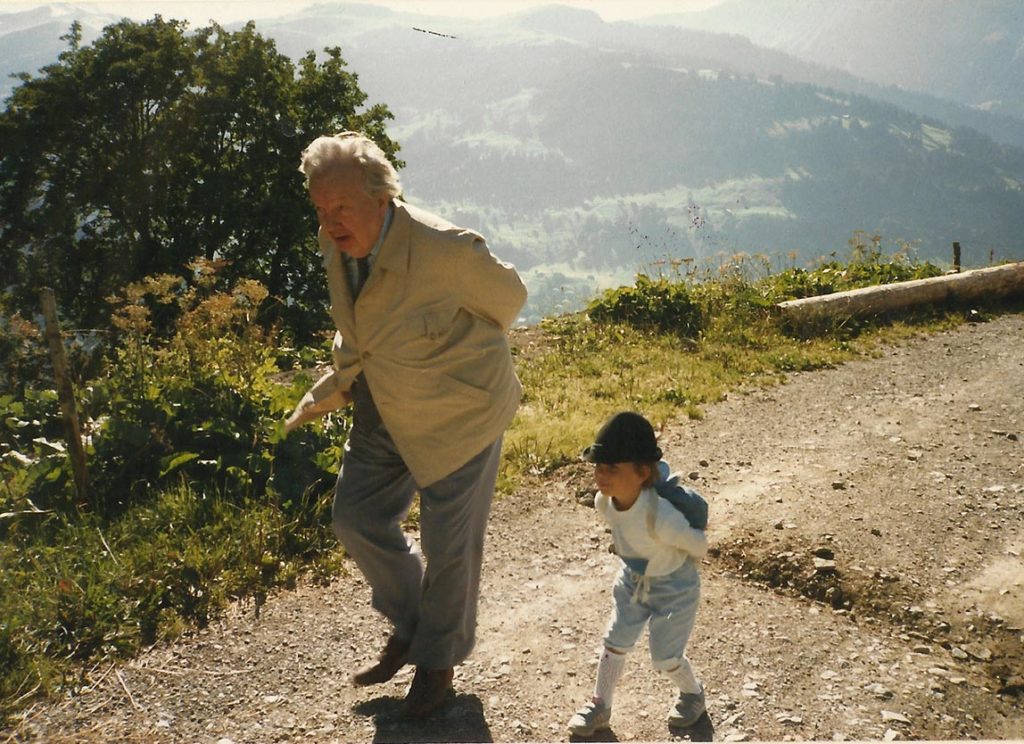
Sándor Végh walking with his grandson ©Susie Mészáros 2020
Teaching someone with special needs
I've taught people with autism and Aspergers, blindness. It's lovely and very revealing for them when they see that they really can reach into music, and making music, just as easily as someone who appears to be more comfortable in the world, who aren't impeded. Because you can show, 'well actually, you're not impeded particularly , but you just have to find a slightly different route in. And once you've found it, there is no issue.
Autistic students can get over focused on certain things. Autistic students can get obsessive about some aspects of playing and lose the balance. It can cause these students to get anxious. I think teaching austistic students music can help their condition quite often, because it gives a lot of confidence. What is learning? You're discovering that you have the ability within you, that it's nothing something from outside yourself. It's about unlocking something that is there already. Playing can be a refuge from other stresses because the playing doesn't always feel like a pressure. I had an autistic student who spent 5 years with me. He rose to the pressures of college and far exceeded his own expectations.
Teaching blind students
Again its about getting confidence with the movements, a blind person has to feel everything they do and they tend to use their hands to feel the world around themselves. For developing violin playing skills, it can involve refocusing away from the concern with the fingers and getting the student to become more aware of their arm positions. For example, having a sense of the angles within their elbows.
Student Feedback
'I studied with Susie for nearly five years at the RNCM and never failed to be inspired by her teachings.
Susie is highly observant and versatile in her approach to education, which in my experience translated into regular use of metaphor and analogy to solidify understanding of a technique.
She has an uncanny sense of when best to be patient or to push for results, which I believe is essential when training in a fast-paced environment. I would describe Susie's teachings as pragmatic: the sound (and player comfort) comes first, with the technique living only to serve that sound.
Throughout my studies, I was encouraged to hone in on my desired sound to guide the technicalities of playing, which allowed for a greater focus on musical expression - which is, of course, the entire point! I wholeheartedly recommend Susie to anyone wishing to expand their technique, musicality and even their general viewpoints on life. I thoroughly enjoyed having her as my mentor, and I hope you do too.'
Karl Egeland, Graduate Royal Northern College of Music, Manchester 2019
Video interviews with viola graduates RNCM 2019-21 transcript
Theo, Viola graduate 2019:
'She's a great teacher. I really like that she can identify really the mistakes in your technique and find a great solution for them. One that you haven't thought about before.'It's not just your hands that are getting trained. It's also your ear. She seemingly has a way of furthering the technique special for every student. It's like she can identify exactly what is missing from someone and teaching them the solution for it in a technical way and that's great.
I've seen her having students that are, at the beginning, not such great players and also working with great players. Something that was really impressive, I was listening to first year students that she has. The first time I listened to them, it was quite horrible. But in a few weeks, a few months, they've changed so much. And they grow so much. It's quite amazing. People from her class won the viola competition, like 2 years in a row at RNCM.
Big improvement. It's actually something that I admire about Susie is that she knows all the, let's say, theorectical classic ways of playing. But she's really open-minded to much more than that. She knows the Baroque interpretation of something, I've heard her, she's been in Baroque ensembles and groups some time ago. But she doesn't ask you to be strict like playing with no vibrato or something. She allows you to have your own voice and your own ideas in the music.
Wanshu 'Susie' viola graduate 2021:
I think if you want to study with Susie you really made a really good choice. She's just brilliant.
The teaching style is really, really different from what it's like in China. Because in China the teachers are really straightforward and quite strict, quite pushy. When I first come here, Susie was really encouraging and really, really nice and inspiring. That's why I felt like, ‘am I doing something wrong?
It changed my way of looking at music because I understand in the Royal Northern music is a self expression. It's got to do with everything else. Your life experience, your perspective of how you say things, your opinions. That's something you don't get told normally.
And I think Susie is really special in that.
Because not only is she teaching me about how to do music, she also teaches me about how to face certain things in my life, if that makes sense. And I think that's really important. Especially as a musician. Because you can't really play good music if you're empty inside. Not meaningful music, anyway. Not for me.'